




18 Nov CNC Turning vs CNC Milling: Which Is Better for Your Parts?
Choosing the wrong machining method can raise costs, slow delivery and compromise quality. Many buyers and designers start by asking whether their design needs CNC turned parts or milled ones, and the answer depends on shape, tolerance, volume and budget. Both methods are powerful, but each excels in different situations. This guide compares the two in plain language, explains where each one shines, and helps you decide which route suits your next project.
Understanding CNC Machining Processes:
Before comparing the two methods, it helps to see how they fit into the wider family of CNC machining processes used in modern factories.
What CNC Actually Means
CNC stands for computer numerical control. A programme tells the machine exactly how to move its tools, so every cut follows the same path. This removes most human variation and allows factories to repeat identical parts hundreds or thousands of times.
Subtractive Manufacturing in Brief
Both turning and milling are subtractive methods. They begin with a solid block or bar of material and remove metal until only the finished shape remains. Materials such as stainless steel, brass, aluminium, mild steel and plastics are all commonly used.
Why the Choice Matters
The method you pick influences tooling, setup time, surface finish and price per part. A design that suits one method may be slow and costly on the other, so an early decision saves money later.
How CNC Turning Works
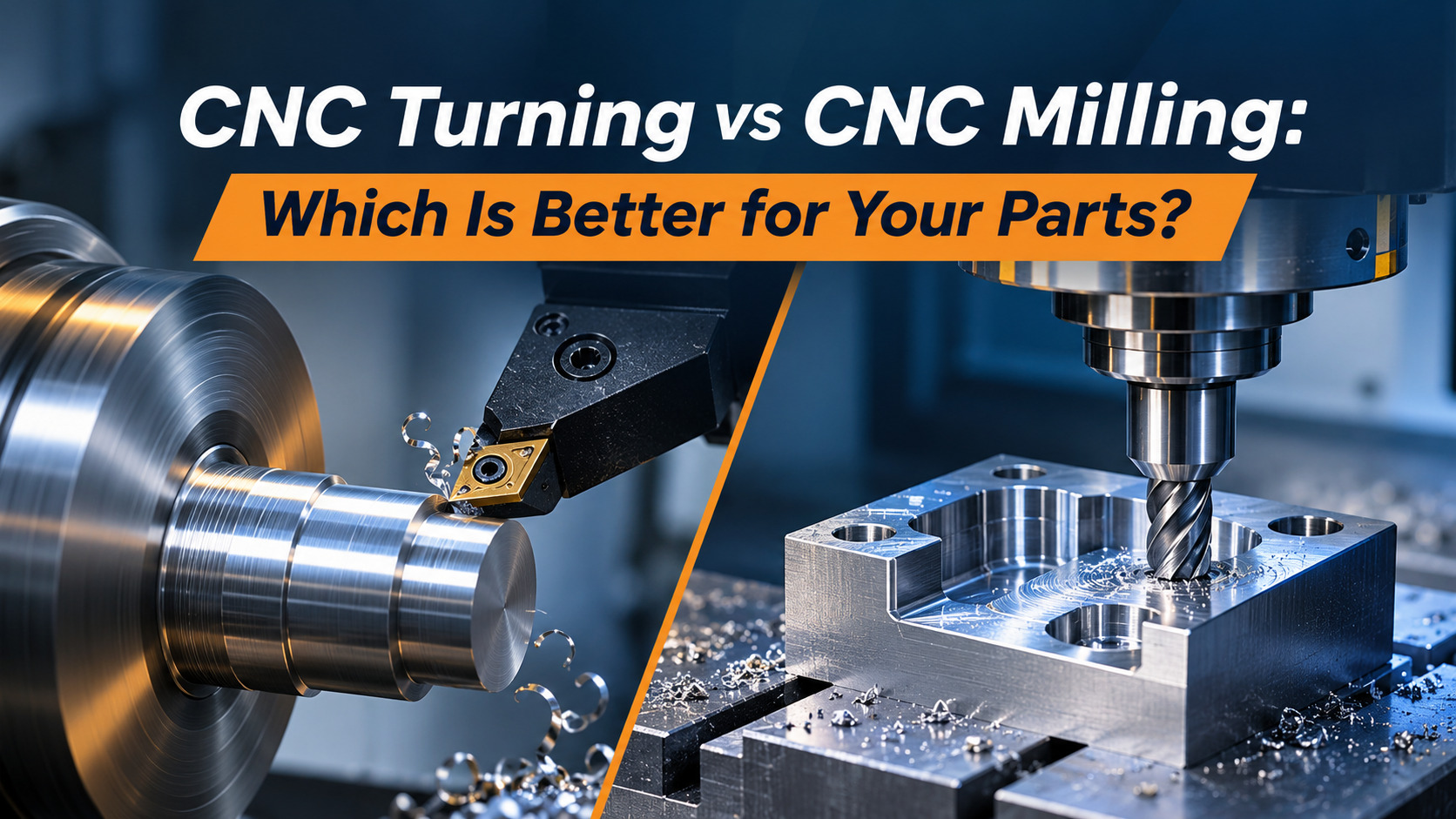
In turning, the raw material rotates at high speed while a stationary cutting tool moves along it. Think of a potter’s wheel, but cutting metal instead of shaping clay.
The Turning Process
A bar is held in a chuck or fed through a spindle. The cutting tool shaves material from the outside diameter, bores holes, cuts threads and forms grooves. Modern lathes often include live tooling, which lets them drill and mill small features in the same setup.
Parts Best Suited to Turning
Shafts, pins, bushes, spacers, couplings, nuts and fittings are classic examples. Buyers who need CNC turned parts components in large quantities benefit from fast cycle times, tight concentricity and excellent surface finishes straight off the machine.
Advantages of Turning
Turning is usually quicker and cheaper per piece for round parts. Material waste is low, tool changes are minimal and bar fed machines can run unattended for long periods, which makes high volume production very economical.
How CNC Milling Works
Milling reverses the movement. The workpiece stays fixed on a table or in a vice while a rotating multi tooth cutter moves across it on several axes.
The Milling Process
The cutter removes material from flat faces, pockets, slots and contours. Three axis machines handle straightforward shapes, while four and five axis centres can reach complex angles in one clamping, which improves accuracy.
Parts Best Suited to Milling
Housings, brackets, plates, manifolds, moulds and enclosures are typical milled items. Any part with flat surfaces, irregular outlines or intricate pockets usually belongs on a milling machine.
Advantages of Milling
Milling offers great geometric freedom. It can produce almost any shape, handle large blocks and create detailed features that a lathe cannot reach. It is also well suited to prototypes and low volume runs of complicated designs.
CNC Turning vs Milling: Key Differences That Affect Your Choice:
When weighing CNC turning vs milling, focus on how your part is shaped and how many you need. A quick comparison shows the main trade offs:
- Turning rotates the part, while milling rotates the cutting tool
- Turning suits round or symmetrical shapes, while milling suits flat and complex shapes
- Turning is usually faster and cheaper at high volumes
- Milling gives more design flexibility and can machine larger components
- Turning delivers superb roundness and concentricity
- Milling reaches pockets, slots and angled features with ease
Part Geometry
Geometry is the single biggest factor. Anything with a central axis, such as a pin or sleeve, points toward turning. Anything with multiple faces, pockets or irregular profiles points toward milling.
Cost and Speed
Turning generally wins on cycle time and unit cost for symmetrical items. Milling often needs more setups and longer machining time, though complex parts may still be cheaper to mill than to fabricate in several steps.
Tolerance and Surface Finish
Both methods can hold tight tolerances, often within hundredths of a millimetre. Turning tends to give a smoother finish on external diameters, while milling provides excellent flatness on planar surfaces.
Why Cylindrical Parts Favour Turning in Most Cases
For cylindrical parts, turning is usually the natural choice because the material already rotates around the same axis as the finished shape. That makes cutting efficient, accurate and repeatable. Milling a round part is possible, but it takes more time and rarely matches the concentricity of a lathe. Still, parts that combine a round body with flats, cross holes or keyways often use both methods, either on a mill turn machine or across two operations.
How to Choose the Right Process for Your Project:
A few practical questions will point you toward the best answer.
Ask About Shape, Volume and Material
Is the part round or prismatic? Do you need ten pieces or ten thousand? Does the material cut easily? Round, high volume items favour turning, while complex, low volume items favour milling.
Consider Combined Processing
Many real world components need both. A valve body may be milled for its ports and turned for its threads. Multi tasking machines reduce handling and improve alignment, so ask your supplier what they recommend.
Prototype First
Order a small batch before committing to volume. Testing fit, finish and function exposes problems early and costs far less than correcting a full production run. When your design relies on CNC turned parts components, this step also confirms that tolerances are realistic.
Working With the Right Manufacturing Partner
Machine capability matters, but so do experience and communication.
Look for Proven Quality Systems
Check for ISO 9001 certification, in house inspection equipment and clear reporting. Request material certificates and first article reports so each batch can be verified against your drawings.
Choose a Partner Who Advises, Not Just Quotes
A good supplier reviews your drawing and suggests changes that cut cost without harming performance. Sunex India works with international buyers on custom turned and milled parts, helping them pick the right method for each design. Experienced partners such as Sunex India can also coordinate samples, inspection and export documentation, so your project moves from drawing to delivery smoothly.
Sunex India serves clients across multiple international markets, exporting its custom CNC turned and milled components to India, Canada, the UK, Saudi Arabia and Germany. With a focus on precision manufacturing, consistent quality and reliable delivery, the company supports businesses across these countries with machining solutions tailored to their technical and production requirements. Whether customers need small prototype batches or large-scale production, Sunex India aims to provide dependable manufacturing support across global markets.
Conclusion
Neither method is universally better. Turning leads for round, high volume items, milling leads for complex shapes, and many parts need a mix of both. Start with your geometry, volume and tolerance needs, test with a prototype, and work with a supplier who explains the trade offs honestly. If you want expert guidance on your next drawing, Sunex India is ready to help you choose the most efficient route.
Frequently Asked Questions:
Is CNC turning cheaper than CNC milling?
For round parts in volume, turning is usually cheaper because cycle times are shorter and setups are simpler.
Can a lathe make flat surfaces and holes?
Yes, a lathe can face ends, drill and bore, and live tooling lets it cut flats and cross holes.
Which method gives better tolerances?
Both hold tight tolerances, with turning excelling at roundness and milling at flatness and positional accuracy.
What materials can be turned or milled?
Stainless steel, aluminium, brass, mild steel, titanium and engineering plastics are all commonly machined.
Can one part need both turning and milling?
Yes, many components are turned first and then milled, or made on a combined mill turn machine.